Recognizing and congratulating employees for a job well done is a best practice in the workplace. It is also crucial for maintaining a positive and productive work environment. Below, we present various ways to congratulate an employee on a job well done. We highlight the importance of these actions and provide practical examples that you can apply in your professional setting.
Content
Why is it important to recognize and appreciate employees' hard work?
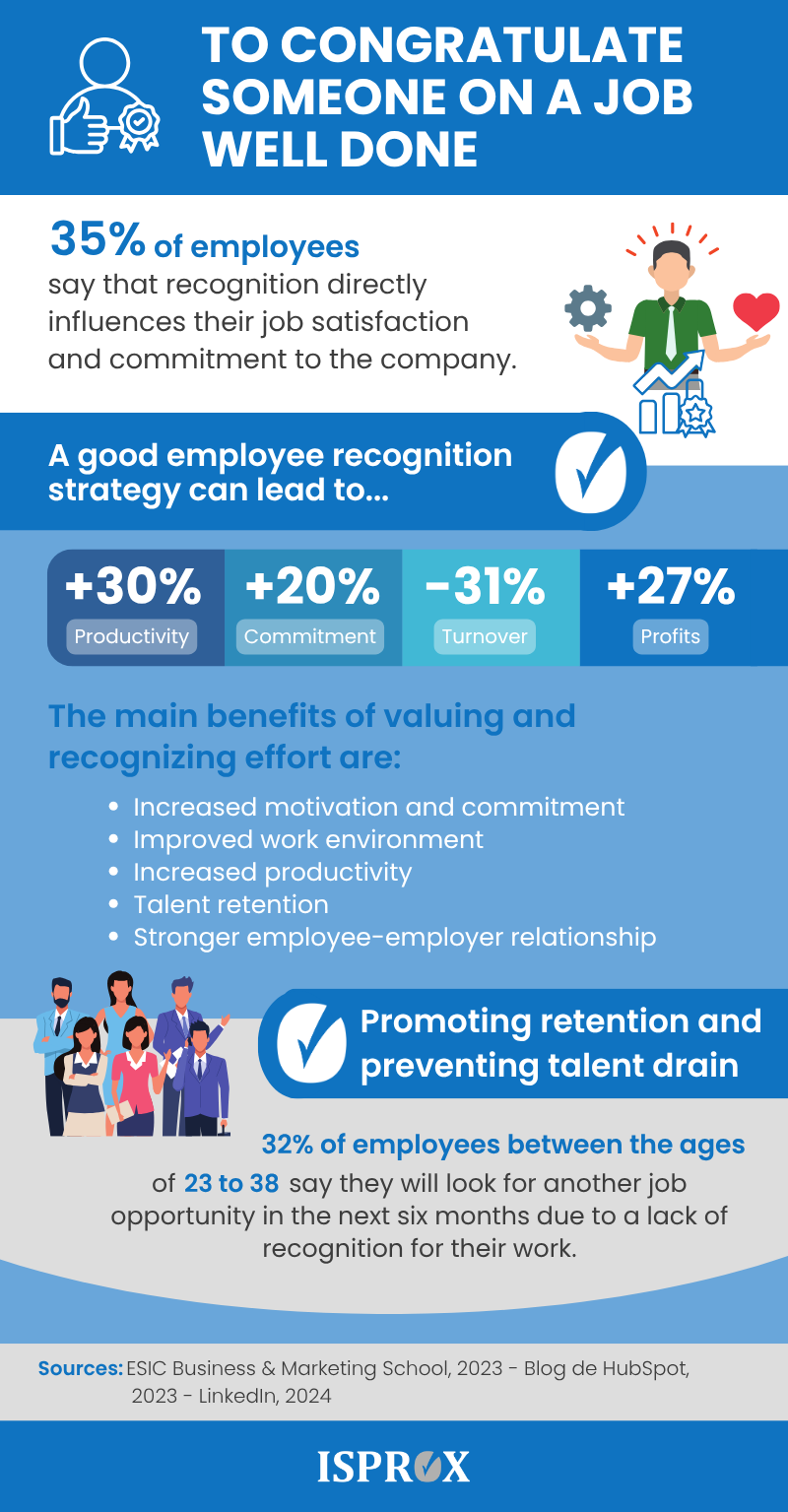
Recognizing a job well done has numerous benefits for employees and organizations. According to a Society for Human Resource Management (SHRM) report, 79% of employees say frequent, meaningful recognition from supervisors directly influences their job satisfaction and commitment to the company.
This study shows that employees who feel valued are more likely to stay with a company long term. This reduces staff turnover and the costs associated with hiring new talent.
Benefits of Recognizing and Valuing Employees' Efforts
Boosts motivation and engagement
Expressing gratitude to your employees for a job well done sends them a clear message that their hard work and dedication are noticed and appreciated. This boosts their motivation and commitment. Motivated employees are more likely to continue giving their all, knowing their work is appreciated and recognized.
Improves the work environment
A work environment in which employees are recognized for a job well done tends to be more positive and collaborative. Employees who feel valued are more likely to work together, share knowledge, and support their colleagues. This fosters a culture of mutual support and respect.
Increase productivity
Employee productivity is closely linked to their sense of satisfaction from a job well done. When employees feel that their work is valued, they are more likely to strive to meet or exceed their goals. According to a University of California study, happy employees are up to 31% more productive than those who do not feel valued in the workplace.
Talent retention
Recognizing a job well done and showing appreciation are essential to retaining top talent. High employee turnover can be costly and disruptive, affecting team morale and the continuity of projects. Recognizing a job well done increases employee loyalty and reduces the likelihood that they will seek opportunities elsewhere.
Strengthens the employer-employee relationship
Recognizing and valuing employees’ efforts strengthens the relationship between employers and employees. This relationship is founded on mutual trust and respect. When employees feel that their work is appreciated, they develop greater trust in management and stronger relationships with their supervisors.
How can I express my gratitude for a job well done?
The art of expressing gratitude for a job well done lies in specificity and sincerity. Below are some tips for writing congratulatory messages:
Use a variety of media: You can offer your congratulations in person, in writing, via email, or publicly at a team meeting.
Sample thank-you message:
Dear Juan,
I would like to thank you personally for your excellent work in developing the new software. Your attention to detail and commitment to the project were crucial to our success. Thank you for your dedication and hard work!”
Recognizing a job well done in various settings
Not all achievements are the same, so recognizing a job well done should be tailored to the achievement's context and nature. Below are some guidelines for different scenarios:
Individual achievements
Personalized recognition is ideal for individual achievements. This could take the form of a private conversation, a thank-you letter, or a small award or incentive.
Team achievements
When a team has worked hard on a project, it’s important to acknowledge their collective effort. During a team meeting, you can do this by highlighting each member’s contributions and explaining how their collaboration led to success.
Outstanding achievements
Consider a more formal form of recognition for achievements that exceed expectations. Examples include annual awards, special mentions in internal newsletters, and recognition events.
Everyday Achievements
Not every achievement calls for a big celebration. Recognizing day-to-day efforts is important, too. A simple "thank you" or positive comment during a meeting can greatly impact team morale.
The Impact of Recognizing a Job Well Done
Recognizing a job well done can have a profound and lasting impact on employee morale and productivity. In fact, according to a Gallup study, companies that implement effective recognition programs see a 14% increase in productivity and a 31% decrease in employee turnover.
Benefits for team morale
● Increases job satisfaction: Employees who feel valued are happier in their jobs.
● Promotes team cohesion: Recognizing achievements fosters collaboration and mutual support among team members.
● Reduces stress: Feeling appreciated can reduce stress levels and improve employees' overall well-being.
Productivity Benefits
● Improves performance: Motivated and valued employees tend to perform better and be more efficient in their work.
● Promotes innovation: An environment that celebrates success fosters creativity and innovation, as employees feel more confident about proposing new ideas.
● Build loyalty: Appropriate recognition can foster employee loyalty, reducing turnover and the costs associated with hiring and training new employees.
Practical examples of expressing gratitude for a job well done
To show how to commend someone for a job well done, here are some examples of effective recognition by team leaders and managers of their employees’ efforts.
Personal acknowledgment
María, a project manager at a technology company, sent a personalized email to each member of her team after they completed a major project. She highlighted each person’s specific contributions and explained how crucial their work had been to the project’s success. She also organized a small office celebration to thank everyone in person.
Public recognition
Javier, the human resources director at a consulting firm, decided to publicly recognize a team that had exceeded its quarterly goals. During an all-hands meeting, Javier highlighted the team’s efforts and dedication. He presented them with a certificate of recognition and a special bonus. This gesture motivated the recognized team and inspired other employees to strive for similar levels of performance.
Formal recognition
Laura, the director of operations at a multinational marketing firm, launched an annual recognition program. Employees nominated colleagues who had performed exceptionally well. Winners received a trophy, a special mention in the company’s internal newsletter, and an extra day of vacation. The program boosted employee morale and engagement.
Common Mistakes in Recognizing a Job Well Done and How to Avoid Them
Although recognition is important, common mistakes can undermine its effectiveness. Here are some of those mistakes and how to avoid them:
Not being specific
Error: Generic compliments like "Good job" or "Thanks for your effort" can seem insincere. They don't show employees that you truly understand and appreciate their efforts.
How to avoid it: Be specific when expressing your appreciation. Instead of saying "Good job," say something like "Thank you for finishing the sales report ahead of schedule. Your detailed analysis was very helpful for our meeting with the client." This shows the employee that you've noticed the details of their work and its impact.
Realizing it too late
Error: Thanking employees too long after they’ve done something well can cause the recognition to lose its impact and relevance.
How to avoid it: Acknowledge achievements as soon as possible after they occur. Timely recognition shows that you’re paying attention and value the effort. Scheduling regular performance review and feedback meetings can help ensure that recognition is timely.
Failing to do so in a balanced way.
Error: If you always recognize the same people, other employees may become demotivated and feel that their efforts are overlooked. This can lead to resentment and the perception of favoritism.
How to avoid it: Be sure to observe and acknowledge the efforts of all team members. Track their achievements and strive to distribute recognition fairly. While not everyone should receive the same level of recognition, every significant effort should be acknowledged.
Do not customize the recognition
Error: A "one-size-fits-all" approach to recognition may be ineffective because every employee is different and has different preferences and motivations.
How to avoid it: Tailor your recognition strategy to your employees’ preferences and personalities. Some employees may appreciate public recognition, while others may prefer private acknowledgment. Getting to know your employees will help you make recognition more meaningful.
Ignoring small achievements
Error: Focusing solely on major achievements may make employees feel as if their day-to-day efforts aren't appreciated.
How to avoid it: Don't overlook small achievements. Recognizing consistent effort and incremental improvements is just as important as celebrating major successes. A simple "Thank you for always being willing to help" can have a significant impact on team morale.
To be inconsistent
Error: Inconsistent recognition can lead to confusion and demotivation among employees. Poor hiring practices can exacerbate these issues by introducing negative dynamics within the team.
How to avoid it: Establish a clear and consistent recognition system. Define specific recognition criteria and apply them consistently. Recognition may include monthly programs, regular feedback meetings, or a points system that employees can redeem for rewards.
Do not link recognition to the company's values and objectives
Error: If recognition isn't aligned with the company's values and goals, it may seem disconnected and less meaningful.
How to avoid it: Ensure that recognition is aligned with the company’s values and goals. For instance, if innovation is one of the company’s values, then recognize and celebrate innovative efforts. This motivates employees and reinforces the organization’s culture and goals.
Praising an employee is a key strategy
Congratulating someone on a job well done is a matter of professional courtesy and an essential strategy for maintaining a positive, productive work environment.
Recognizing a job well done in a specific, sincere, and timely manner can boost morale, improve productivity, and foster team loyalty. Applying the strategies and examples mentioned in this article will ensure your employees feel valued and motivated to continue doing their best work.
At ISPROX, we understand the importance of recognizing and valuing talent. As a consulting firm that specializes in talent recruitment, we know that a company’s success largely depends on its employees' satisfaction and motivation. Implementing these recognition practices will benefit your employees and your organization as a whole.
.svg)
 Spanish - Spain
 Catalan
 English
 Portuguese
 French
 Spanish - Mexico