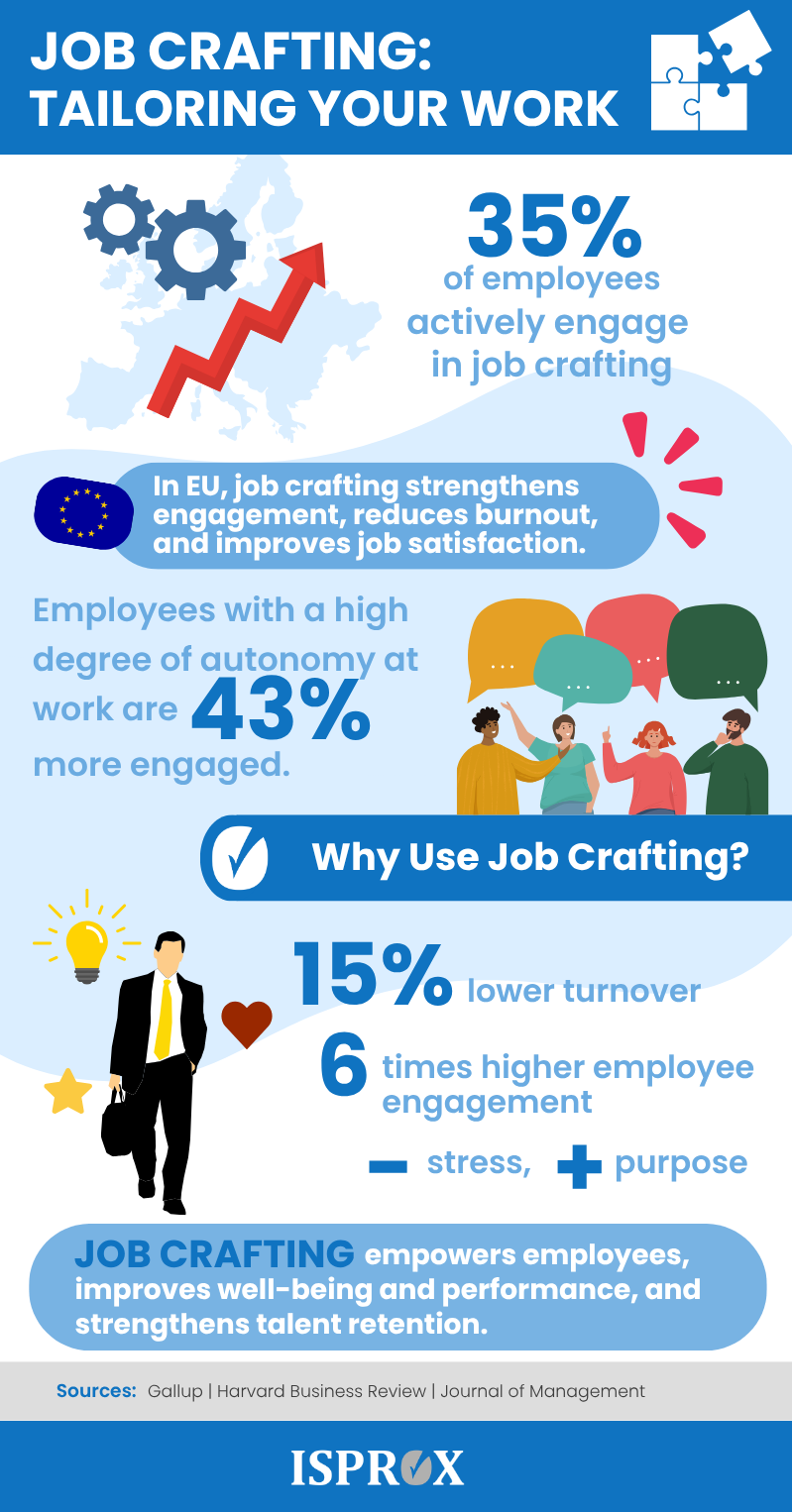
How can you incorporate job crafting into your daily routine?
Implementing job crafting may seem challenging at first, but it is a gradual and accessible process. You don't need a radical transformation to get started.
The structure of the work can gradually be integrated into the way we support and manage the team. Below is a step-by-step guide with practical examples and information to encourage you to take the first step.
1. Encourages individual reflection
It helps each person to identify their strengths, passions, and how they would like to spend their time more (or less) effectively in their day-to-day lives. According to a Gallup study, employees who utilise their strengths at work are 15% less likely to resign and six times more likely to be engaged.
2. Map tasks and relationships
Work with the team to analyse their current tasks, noting down who they usually collaborate with, how much time they devote to each task and the value of each task. This often reveals clear opportunities for improvement.
3. Identify crafting opportunities
Based on the assessment, work together to find ways of adapting the work that benefit both individuals and the team. How can you achieve this? Employees can look for areas where they can apply the three types of crafting by asking themselves questions such as the following:
Task Crafting: Can You Delegate Repetitive Tasks? Is there a task that you enjoy doing which you could do more of? Could you take on a new responsibility that aligns with your interests?
Relational Crafting: Who would you like to interact with more to learn from or collaborate with? Are there relationships you can improve or handle differently to reduce friction?
Cognitive Crafting: How can you reframe a boring task to see its broader impact? How do you see your role as an essential part of the company's mission?
4. Include him in the development discussions
Including job crafting in evaluations, feedback sessions and career plans helps to ensure that it becomes an ongoing practice rather than a one-off event.
Practical Examples of Job Crafting in Different Industries
● In Technology (Software Engineer): A junior software engineer has become disillusioned from working solely on fixing bugs. Realising that his strengths lie in communication and teaching, he volunteers to lead internal training sessions for new employees.
● Healthcare (Nurse): A nurse becomes demotivated by the routine of hospital life. She realises that her passion lies in meaningful human interaction and providing emotional support. She starts spending a few extra minutes talking to patients and their families, not just about their medical conditions, but also their concerns and hopes, offering a more holistic approach to care.
● In marketing (SEO Specialist): SEO specialists spend most of their time on keyword analysis and technical optimisation. However, he is passionate about storytelling and content creation, and therefore takes on part of the content strategy, bringing a fresh perspective to the team.
● In finance (Financial Analyst): A financial analyst, feeling trapped by repetitive reporting, discovers that his strength lies in mentoring and developing people. He begins mentoring junior staff, thereby improving team cohesion and internal learning.
Technology and tools to facilitate job crafting
Although job crafting is an individual process, technology and digital tools can facilitate its implementation and management for employees and managers alike.
This isn't about specific 'job crafting' software, but rather how existing tools can be used effectively to support this philosophy.
Performance Management and Continuous Feedback Platforms
Platforms such as Workday, Lattice, and Culture Amp allow employees to set clear goals (OKRs or KPIs), track progress, request and receive 360-degree feedback from colleagues and managers, and keep track of the skills they’ve developed. An employee can use these tools to document new projects or tasks they’ve “crafted,” demonstrate their impact, and request specific feedback on how those changes are contributing to the team.
Collaboration and Project Management Tools
Platforms such as Asana, Trello, Jira, and Microsoft Teams are essential for visualizing tasks, managing workflows, and facilitating communication. They enable employees to identify where there is flexibility in their tasks, what can be automated or delegated, and how they can collaborate in new ways. They facilitate “task crafting” and “relational crafting” by allowing for a more fluid organization of work.
Automation and low-code/no-code software
Tools such as Zapier, Microsoft Power Automate and Airtable enable employees to automate repetitive tasks and create customised workflows without requiring advanced programming skills. This is essential for “task crafting”, as it frees up time for more valuable and engaging activities.
Pulse survey and anonymous feedback platforms
While they are not direct job-crafting tools, they enable organisations to assess their employees’ well-being and engagement. The data collected can help managers to identify opportunities to encourage job crafting at team or department level and to understand the impact of individual initiatives on the work environment.
What if job crafting were a key driver of your talent strategy?
Job crafting is much more than a trend; it is a work philosophy that empowers individuals and strengthens organizations.
It's not about letting everyone do whatever they want. Rather, it's about giving each professional the space to contribute based on their strengths and motivations, while ensuring that they are always aligned with the goals of the team and the company.
At a time when attracting and retaining technical talent is a challenge for everyone, this philosophy can make all the difference. It doesn't require large investments, but it does require a culture of trust, active listening, and continuous development.
As recruitment specialists, we at ISPROX believe that creating flexible, people-centred and personalised work environments is essential. It is essential for competing and growing with a team of committed and motivated employees.

.svg)
 Spanish - Spain
 Catalan
 English
 Portuguese
 French
 Spanish - Mexico