The way in which an organisation structures its teams and workflows can be a determining factor in its success. Although traditional hierarchical models have long been dominant, an increasing number of companies are now exploring alternatives that promote agility, collaboration and empowerment.
One such alternative is the flat organisational structure. This approach is gaining ground due to its ability to optimise communication and decision-making. We have been implementing it at our human resources consulting firm since its inception.
In this article, we take an in-depth look at what a flat organisational chart is, its characteristics and how it differs from a hierarchical organisational chart. We also explore the different types that exist. We will analyse its pros and cons and, most importantly, provide you with a practical guide and examples of how you can implement one in your own company.
Content
What is a flat organizational chart, and what are its characteristics?
A horizontal organisational chart, also known as a flat organisational chart, is a structure that minimises hierarchical levels to promote direct lines of communication and a more efficient flow of information between employees and senior management.
Unlike traditional models with multiple layers of management, a flat organisational structure aims to break down barriers and encourage collaboration between different teams.
The essence of a flat organisational structure lies in its focus on efficiency and autonomy. Rather than a long, bureaucratic chain of command, it empowers employees to make decisions and take responsibility for their tasks, often leading to greater motivation and productivity.
In short, there are few hierarchical levels. This is the most distinctive feature. The number of management layers between front-line employees and senior management has been significantly reduced, facilitating faster communication and more direct decision-making.
Difference Between a Horizontal and a Vertical Organisational Chart
Understanding the differences between a flat organizational chart and a hierarchical one is essential to choosing the right structure for your company. Although both aim to organize employees, their underlying principles and their impacts on culture and performance are diametrically opposed.
A vertical organisational chart, also known as a hierarchical organisational chart, is the traditional model of organisational structure. It is characterised by multiple levels of management and a clear chain of command extending from top management to lower-level employees. Authority and responsibility flow from the top down.
In this type of organisational structure, communication tends to be one-way and formal, following the established hierarchical channels. Decisions are typically made at the top and then communicated downwards.
In a vertical organisational chart, for example, a marketing employee might report to a marketing coordinator, who in turn reports to a marketing manager, who then reports to a marketing director and so on up to the CEO.
This structure provides clarity regarding roles and responsibilities, and is common in large corporations with standardised operations. However, it can impede decision-making processes and stifle individual initiative.
Types of Horizontal Organisational Charts in a Company
Flat or streamlined organizational chart
This is the purest form of a flat organisational chart. It is characterised by having as few hierarchical levels as possible — often just two or three: senior management and work teams.
Extensive authority is delegated to front-line employees, who have considerable autonomy in day-to-day decision-making. This model is ideal for start-ups and small businesses that value agility and direct communication. Communication is almost always lateral and bottom-up, with minimal management intervention.
matrix organisational chart
Although not entirely horizontal in the sense of eliminating all hierarchy, the matrix organisational chart incorporates horizontal principles by combining a traditional vertical functional structure with a horizontal project-oriented structure. In this model, employees report to two managers: a functional manager, such as the marketing manager, and a project manager.
This encourages cross-departmental collaboration and the sharing of resources for specific goals. This is common in technology, consulting and engineering firms, where collaboration on projects is essential. For instance, a web designer may report to the head of design (functionally) and to the project manager for a new application (on a project-by-project basis).
Advantages and Disadvantages of a Company's Flat Organisational Structure
Although implementing a flat organisational structure in your company can bring a number of significant benefits, it also presents certain challenges that must be carefully managed. It is therefore important to consider both sides of the argument before deciding on this structure.
Advantages of a flat organisational structure:
Disadvantages of the flat organizational structure
Possible lack of clarity regarding roles and responsibilities: With fewer hierarchical levels and a broader span of control, ambiguity may arise over who is responsible for which task or decision, particularly in the absence of clear communication and well-defined processes.
How do you create a horizontal organisational chart?
1. Assess your current culture and strategic goals
Analyse your company's existing culture before making any changes. How open is communication? How empowered do employees feel? What are the weaknesses of your current structure?
2. Define the vision and principles of your new organisational chart.
Describe what your horizontal organisational chart will look like and how it will function. This should include:
3. Clearly define roles and responsibilities.
Although autonomy is encouraged, it is essential that every employee understands their role and responsibilities, and how their work contributes to the company's wider objectives.
Define accountability matrices (RACI): Use tools such as the RACI matrix (Responsible, Approves, Consulted, Informed) to clarify who is responsible for each task, who must approve it, who must be consulted, and who must be informed. This reduces ambiguity.
4. Empower your teams and employees
The foundation of a flat organisational structure is autonomy. For this to work, you must trust your employees and provide them with the necessary tools.
Invest in training your employees in key skills such as problem solving, decision making, communication and leadership. According to a 2020 PwC report, companies that invest significantly in their employees' professional development see a 16% increase in productivity.
5. It fosters a culture of open communication and continuous feedback
Communication is the cornerstone of a flat organizational structure.
Example of a horizontal organizational chart for a company
In a horizontal model, the structure would be drastically simplified. Let's imagine the following configuration:
Company: InnovaSoft (Software Development)
Structure:
Chief Executive Officer (CEO): The role of a single leader is to set the company's overall strategic vision, make high-level decisions, and direct the company. This role is more akin to that of an enabler and visionary than a micromanager.
Self-Managed Product Teams: Rather than being organised into rigid functional departments, InnovaSoft is structured into cross-functional product teams. Each team is responsible for a product or key feature, and is given the autonomy to design, develop and launch it.
Each product team would consist of various roles working collaboratively:
Product Owner (Product Leader): Responsibilities include defining the product vision, prioritising the backlog and representing the customer's voice. This is not a hierarchical "boss" role, but rather that of a facilitator and key communicator.
Human Resources/Organisational Culture: Its areas of focus include recruitment, talent development, wellness management and promoting the company culture. It collaborates closely with all teams to support their staffing requirements.
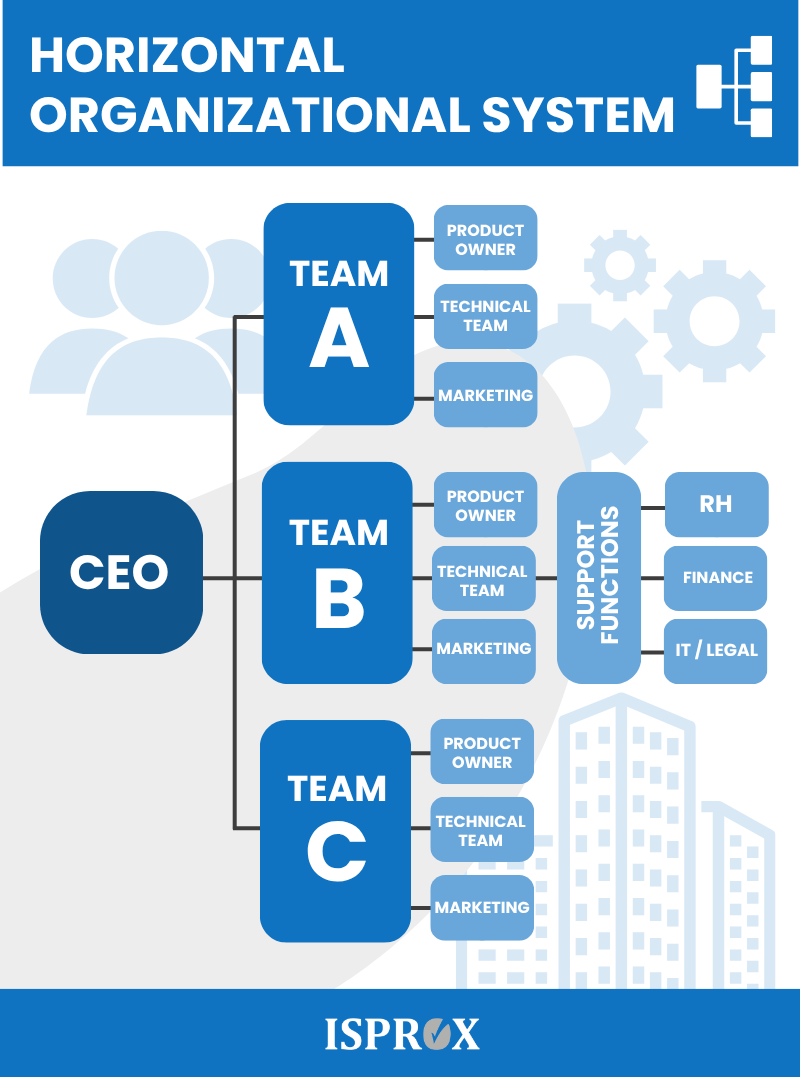
Communication and Operational Workflows:
Conclusion
The flat organisational structure represents a fundamental shift in how companies are structured and operate. It is not a passing fad, but a response to the need for greater agility, innovation and empowerment in an increasingly dynamic business environment.
By reducing hierarchical layers and encouraging direct communication, this model enables organizations to be more responsive, foster a culture of trust, and give their employees the autonomy to make impactful decisions.
However, we have also recognized that it is not a one-size-fits-all solution and that it presents challenges, such as potential ambiguity in roles or the need for highly autonomous employees—factors that can be assessed during the hiring process.
The key to success lies in careful implementation, which includes clearly defining roles, investing in training, and fostering a culture of continuous feedback.

.svg)
 Spanish - Spain
 Catalan
 English
 Portuguese
 French
 Spanish - Mexico